Examples of How Math Works in Real Life

I like to tell my kids that math is not boring, after all I use it everyday whether at the store or in the kitchen. Balancing checkbooks, fixing up recipes, and buying groceries are just a few examples of math in my life. But as a family we do more than those activities. Girls like to  sew and the boys like to build. We also are into graphic design and computer science. These activities contain math.

In the Kitchen:
When you cook you use fractions. Have the kids prepare a meal and tell them to double or triple the recipe. You can freeze the difference as equivalent  family meal amounts for you to eat at another time. Your child will learn math and also acquire a few other skills like meal planning and  preparation plus time management.

Construction:
Pick a project that demands measuring with tape different distances. My son and I are going to try to build a tower for a flower garden from scratch pallets. Construction allows you to practice geometry, addition, substraction, division, multiplication, and so on so forth.

Interior Decoration:
If you paint a room in the house have the kids join in this task.  Analyze with your child how much paint you will need to buy by reading the back label of the paint at the store. Don't forget the calculator.

At home:
Kids can waste resources easily. They don't have to pay for rent, utilities, food, clothing, and transportation. And those are basic necessities! Let's not mention the wants. Yeah, all those things that allow us to have fun!
I have been slowly but surely reminding the kids to help save on resources and have included telling them how much each thing costs. They have a clear picture in their mind and they try to help.

Also try to have them measure different rooms and figure out the square footage of such rooms. Walls can be measured as well. And for a greater challenge have them measure the perimeter of the  house or property. They can  walk around  it by counting the number of steps that they take to measure the perimeter.
For younger students have then measure the dining room table or coffee table. Encourage also measuirng the surface area of 3D objects like a cereal box. Check out this video to brush up on this concept: Surface Area of Three Dimensional Figures,

At the Store:
Let the kids make purchases. As you supervise you can see how much your child knows and where you need to work on. I let my teenagers purchase supplies for our house.

At the gas station:
My teenager son helps me gas up the vehicle. He is learning how much money it takes to fill  up the car and to know how much gallons to purchase when the tank is at different levels. He will soon be driving so he needs to learn this skill.


Sewing:
Follow tutorials for drafting patterns for clothing or craft projects. I made a skirt following this pattern. I follow different sites or videos that are user friendly. When creating a pattern you have to work with geometrical shapes, measurements, and fractions.

How To Create A Sewing Pattern

Computer Games:
If kids love playing on computer then allow them to build in Minecraft. These game allows for a lot of creativity. It uses only blocks and I have seen some very amazing projects done with this game. Have kids do school projects in this game. I always tell the kids no zombies allowed while building in school hours.

Google Minecraft buildings to see what can be done with this game.

My kids are building a city and and one is working on  a replica of the Ziggurat.
Another game place that I love for them to explore is Scratch. It uses a cordinate plane and there is a lot of Algebra that can be practiced creating functional games there. Kids play there, learn from experts, and build their own games.


Graphic Design:
One software that I have really fallen in love with because is free (for now) and also fun to learn with is Blender. Kids can create tridimensional (3D) art with this tool. It also uses Algebra as you have to depend on  x, y, and z axies .


Music:
My family is very musical and we like to come up with different music compositions. Music is a composition of notes, each holding a note value (beat and sound), with steady  mathematical arrangements. Sometimes there is a display of quiet breaks still subjected to the musical composition of the whole piece. We all play different instruments so we have to learn how to count for the sake of music!  Here a couple places to show you more about music and the math that goes with it: Musical Form and Song Structure


Also check out this video:


Something fun to explore:30 apps to make music on mobile devices

Dancing:
Dance is a coreographical arrangement of patterns and mathematical count. Have kids learn a dance that demands counting the steps. 
I really love how the coreography works here with visual effects:


Because I have some kids working with Algebra at the moment I try to find inspiring material for them in this journey of math. Here is some great resources in that vein of thought:Homeschool Algebra

I imagine that dad works with mathematical problems at work. Ask dad to tell the kids which math he uses at work. Ask them to teach the kids a simple yet challenging problem. Help them reason from beginning to end. If it takes having the kids learn new mathematical facts then do it.

A while ago, I learned  that languages can be translated with the aid of math. That is the world of linguistics. Here is a 1971 document by Wycliffe describing this skill as it relates to mathematics: Christian Linguistics.
"The tools of mathematics can be adequately applied to language structures only by people actually at work in language analysis. This requires a competence in both linguistics and mathematics"
Also read more on: Mathematical Linguistics

One more thing I would like to say is that math is everywhere really. The fields of science and history also have a good measure of math in them. A few examples are the formulas used in physical science and in chemistry. Time is a little word but it really contains a lot of numbers when you think of it in the context of history and even day to day living. Just managing our busy schedule demands a synchronized management of time.  Think of the places math is around you and work out mathematical problems with the kids. Anyplace and  anywhere is a learning opportunity! Math is just a reflection of how amazing God has created everything. It takes a few brilliant minds to unravel some of the deep mysteries of math and there are some mysteries yet that cannot be reached with the human mind. One of the largest number that can be counted by a human machine  is the googol (10100)! Check out all the zeros contained in this other large number by clicking this link:googleplexian  Yet no one and nothing that is terrestrial can count beyond that yet there are numbers that keep going beyond these human or machine countable numbers.

image by Information In

Here is an attempt my daughter made at typing a  large number. She got so dizzy so that is why she mirrored the image on the left.


Algebra 2


10/10/14 Do Day 2 and Day 3 of Algebra 2 here after you study information below. Make sure to visit each of the links provided as well.

Day 2 and 3 Study Guide

Common Number Sets
name all the sets of numbers to which each real numbers belongs. Let N=natural numbers. w=whole numbers. z=integers. q=rational numbers, and i=irrational numbers.
Natural numbers: 1, 2, 3, ...
Whole numbers: 0, 1, 2, 3, ...
Integers: ..., -3, -2, -1, 0, 1, 2, 3, ...
http://www.mathsisfun.com/sets/number-types.html

Multiplicative Inverse of a number http://www.mathsisfun.com/definitions/multiplicative-inverse.html

Mean,  Median and The Mode http://goodschoolingstuff.blogspot.com/2014/08/meanmedianmode.html

10/13/14
Do day 4 and 5  of Algebra 2 here

10/14/14
Day 6 study guide
Absolute Value http://coolmath.com/prealgebra/08-signed-numbers-integers/04-signed-numbers-integers-absolute-values-01.htm
Watch " Absolute Values" in Khan Academy here
Read
1. SOLVING EQUATIONS CONTAINING ABSOLUTE VALUE(S) Part 1
2. SOLVING EQUATIONS CONTAINING ABSOLUTE VALUE(S) Part 2

Quiz quiz for absolute values

10/15/14  Do day 7 and day 8
of Algebra 2 here

10/16/14
Do day 9 and day 10 of Algebra 2 here

10/17/14
Do day 11 of Algebra 2 here

Second Grade Math

Penmanship, cursive, and note taking

I do believe that learning penmanship is very important for the kids. My kids need to improve and also learn how to write faster. My sister remind me of how we schools in Colombia did it when we were growing up. There was a lot of practice with strokes and shapes. It seems strangeat first but reality is that I was able to write fast. I am able to take notes when being lectured for 3 hours. That is a skill! And kids need to learn the skill of good penmanship and note taking  for their future!

So let's start with cursive:

Print and trace several times during the week and then copy on a different cursive blank paper:

Cursive Practice sheets

Cursive practice sheets in Spanish

Imagen: ejercicios de caligrafia
more of this type of exercises here

This website has a video showing how each letter is formed. Click on the letter you want to learn, then watch video, and then print exercise for that letter: Caligrafia


Also practice print with this wonderful practice sheets: Handwriting Print worksheets

For those interested in pursuing a high challenge and a very aesthetic skill  try calligraphy. Get calligraphy pen set and books to learn from your local library.


For note taking some of the ideas I can give you is to have your child take notes when they hear a narration or educational audio. I encourage my kids to take notes at church while the pastor preaches. The notes in the beginning won't be perfect but with consistency it should get better.

Read Aloud Correctly for Slow Readers plus Speech

Many students struggle with reading and I have found that making them read aloud  improves their vocalization of correct punctuation. Make sure kids read everyday. I make my kids read 7-8 pages of a literature book a day on their own. Then practice aloud  a page worth of reading from any source you choose often to make sure they are reading properly and that their are meeting a bench mark of fluency for that school year. Try having the kids do skits. That will help them develop speech and correct enunciation, This is a fantastic tool and should be used during the school year. Try one skit a semester. Do more if you want. Here is great resources on theather and drama from AtoZ homeschooling: Drama, Scripts, and Skits


  • Here are is a collection of Christian poetry : Children's Christian Poetry
  • A childhood short story: Little Red Riding Hood
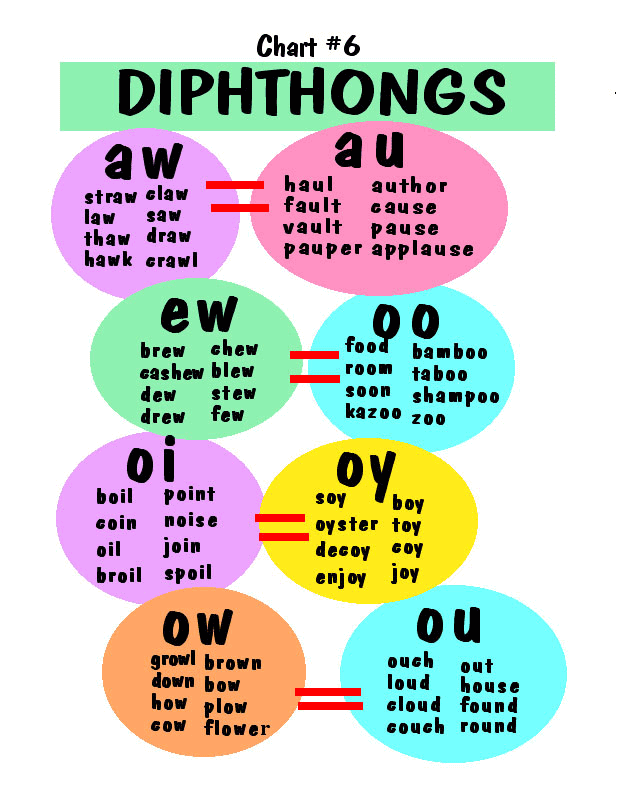
  • Make kids read a list like this Diphtong Word list often.  
  • Although it may seem annoying they can benefit by reading them aloud and it will help them with big words that contain diphtongs.
  • Record the children reading. It can help them hear themselves. Have them hear a passage of Scripture online from Bible Gateway Audio and then have them record that same passage of Scripture and hear themselves. Talk about voice inflections and correct punctuation. Use the method described below on "cold/hot reads".


Here is some online resources to practice with from Fluency Boot Camp:


"EXPRESSION

Expression= Reading with feeling in your voice
  • Changing your voice to match a character
  • Reading like you would speak (and not like a robot!)
  • Moving your voice up and down"

"PUNCTUATION

Punctuation = Reading with attention to punctuation
  • stopping at periods . . .
  • taking breaths at commas , , ,
  • making your voice go up for question marks ? ? ?
  • showing excitement for exclamation points ! ! !
  • using “quotations” to change voice for characters"
She recommends kids read phrases and passages. Make sure to use a timer or stopwatch. Try her formula and keep a record:

(WPM = Total # words in passage multiplied by 60 (seconds), then divided by the total number of seconds the students read)

She has a record keeping chart you can download here

"PACE

Pace = the speed in which you read
  • The goal is to read at a “just right” pace
  • Reading not too fast and not too slow
Speed Drills — Speed drills build fluency because they help students quickly recognize letters, words, word families, common syllables, and spelling patterns in multi-syllabic words (depending on your grade-level). Students love trying to beat their score, especially those who have an extra competitive gene in them! I typically do 1-minute partner drills and have the students graph their progress for each attempt!
Reading Passages (Cold/Hot Reads) — Cold and hot reads are perfect for students to see their progress in their reading pace after practice! A “Cold Read” is when a student reads a passage for the very first time (no practice). A “Hot Read” is when the students are warmed-up and have practiced the passage a few times. Students can time themselves or work with a partner! I have my students set a goal for themselves… typically it’s words per minute (wpm) range for themselves, so they have a number to shoot for! They color this range in or block it off with a highlighter on their graphs."
These wonderful resources per grade levels will be interactive. You will need to print and have the student do the activity. All the activities are towards the bottom of each page:
K-1 activities
2-3 activities
4-5 activities

Read as many  phrases as you can in  one minute. Scroll down the page to see all phrases here. There are 83 cards. Write down the results.

Check out these sample activities:
                                                                       Synonym Bingo


-----------------------
Cute ideas:


Speed Reading: Make more free time out of your busy school schedule!


Learning to read faster and still retain high levels of comprehension is a wonderful tool for success. If you love free time from school work train your brain and your eyes to read faster.

Check out all these links!
Eliminate Subvocalization
Try entering a paragraph at a time into this nifty free online fast reader app and then read it there:
Zapreader
or
Accelareader (with this one you can control the settings)
When your reading assignments contains diagrams or pictures related to the content then do this:

Go to your local library and read books on speed reading. I love those that have drills and exercises.
Do you get annoyed by content on the interent loaded with annoying ads? "Readability turns any web page into a clean view for reading now or later on your computer, smartphone, or tablet." Go to Readability to learn more!


Try finding  what speed reader tools you may find useful for pc or devices.
Here is some names to give you a start.
  • RSVP Reader for Firefox This one is for your pc. It will flash content at a fast speed. You can control the speed.
  • For the sake of eye and brain speed reading training and  if you have a smartphone try these apps recommended here
  • A Faster Reader for devices
  • Balto Speed Reading

Learn Spanish

Spanish I
This a 180 day course
Start with day 2

Spanish 2
This a 180 day course

Marine Biology

Click on links of interest below:

Oceonagraphy with Lab: This is based on 180 days. A complete free online curriculum.

Sea Turtle Unit Study

Christian Biologists

Sand Dollar Unit Study

With anything online please be aware that  most content is not written with a Christian perspective in mind. So be aware of terms related to evolution, global warming, animal activism, enviromental activism, and so on so forth. Learn what is good and and what are facts and put the other stuff in the garbage.

Free Liberty University American History Class

Liberty University has an open Course for American History .

Sign up for their class here


180 Days Homeschool Attendance Calendar

Free printable: A 180- days homeschool calendar for the 2014-2015 school year. This calendar is divided into 4 segments of 45 days each. It will be easier to view and fill out. You will notice the progress being made as you mark each square per day of homeschool work your child makes. You can print one per child and give them a copy so they can mark it themselves. Each square signifies one day of school.  Emphasize the importance of daily schoolwork.

   Student name Calendar. Make sure to click  here to print!

                           Simple Calendar. Make sure to click  here  to print!


Wordly Wise

Great online vocabulary study program. After you click desired link check the bottom of their page to find a video  game icon. After  4-5  lessons you can click and enjoy some related fun educational video games that go along with those lessons. Give it a try!

2nd grade :Wordlywise3000 Book 2

3rd grade:  Wordlywise3000 Book 3

4th grade: Wordlywise3000 Book 4

5th grade: Wordlywise3000 Book 5

6th grade: Wordlywise3000 Book 6

7th grade: Wordlywise3000 Book 7

8th grade: Wordlywise3000 Book 8

9th grade: Wordlywise3000 Book 9

10th grade: Wordlywise3000 Book 10

11th grade: Wordlywise3000 Book 11

12th grade: Wordlywise3000 Book 12


Enseñar literatura a niños


***Padres por favor lean  primero antes de introducir a los niños material de lectura para asegurarse que no intervienen con sus principios y valores establecidos para su hogar. Asegurese que su hijo/a leen varios libros o obras literarias durante el año. Aqui les regalo un plan de estudio!

La siguiente pagina de internet esta llena de fabulas: EDYD. La fabula a continuación es un ejemplo de las fabulas que podras encontrar en el recurso de internet mencionado anteriormente.

.
001 - El águila, el cuervo y el pastor
Lanzándose desde una cima, un águila arrebató a un corderito.
La vio un cuervo y tratando de imitar al águila, se lanzó sobre un carnero, pero con tan mal conocimiento en el arte que sus garras se enredaron en la lana, y batiendo al máximo sus alas no logró soltarse.    
Viendo el pastor lo que sucedía, cogió al cuervo, y cortando las puntas de sus alas, se lo llevó a sus niños.
Le preguntaron sus hijos acerca de que clase de ave era aquella, y les dijo:
- Para mí, sólo es un cuervo; pero él, se cree águila.

Moraleja: Pon tu esfuerzo y dedicación en lo que realmente estás preparado, no en lo que no te corresponde.


 Es importante que el estudiante aprenda a diferenciar entre los cuentos y las historias reales. Deja al estudiante leer las fabulas y observa como los personajes aveces hacen acciones humanas como una animal hablando o un conejo caminando en dos pies. Esto se llama personificación. Observe esta presentación de dispositivas para aprender mas sobre los recursos literarios usados al escribir una obra literaria.


El Progreso del Peregrino es un libro lleno de alegorias.

La alegoria:  Es una figura literaria o tema artístico que pretende representar una
 idea valiéndose de formas humanas, animales o de objetos cotidianos. (Wikipedia)

En la Biblia la historia que Jesus cuenta del Hijo Prodigo es una alegoria.

"John Bunyan (1628-1688) era un predicador y escritor puritano que nació en Elstow, Inglaterra. Escribió El Progresso del Peregrino durante sus doce años de encarcelamiento en Bedford. Después de recuperar la libertad se convirtió en el pastor de una iglesia en Bedford, Inglaterra."


The Hardy Boys en Español seran emocionantes para los varoncitos.

Anima a tus hijos a leer biografias de personajes historicos y/o famosos que ellos admiran. Me encanta tambien que aprendan de inventores. 

Mas cuentos:
Caperucita Roja
Los Tres Cerditos

Estudia esta presentación de dispositivas para aprender un poco mas. Un nivel mas alto pero si tienes niños curiosos por aprender les puedes mostrar. Como maestro usa esto para repasar estos datos importantes:


Presentación por Spanish 4 Teachers


Escoge un guion de obra y realizala con tu hijo o tu hijo con otros estudiantes:
La Hormiga Y El saltamontes
Los Tres Cochinitos
El Zorro y el Caballo
Descubre mas guiones aqui 


Actividad con comprensión de lectura
Hansel y Gretel
El Soldadito de Plomo
descubre mas actividades aqui

Es importante que el estudiante tambien se acostumbre a leer e interpretar poemas.
Poemas Infantiles


Una mirada en las tecnicas literarias encontradas en la Biblia.
What kinds of literary techniques are used in the Bible?
Aqui les regalo el documento traducido :¿Qué tipos de técnicas literarias se usan en la Biblia?

Intermediate Algebra

I need my son to review Algebra at this level for an upcoming test. This is a wonderful website. Take a look: Intermediate Algebra

Florida State Unit Study

Need to study Florida State history? Check out the unit study from Joy  and Successful Homeschooling on Florida State. You don't have to follow the dates or locations suggested.

Personal Finance

I am looking for free resources on personal finance for homeschoolers and came across this wonderful resources:  Personal Finance Free Resources